
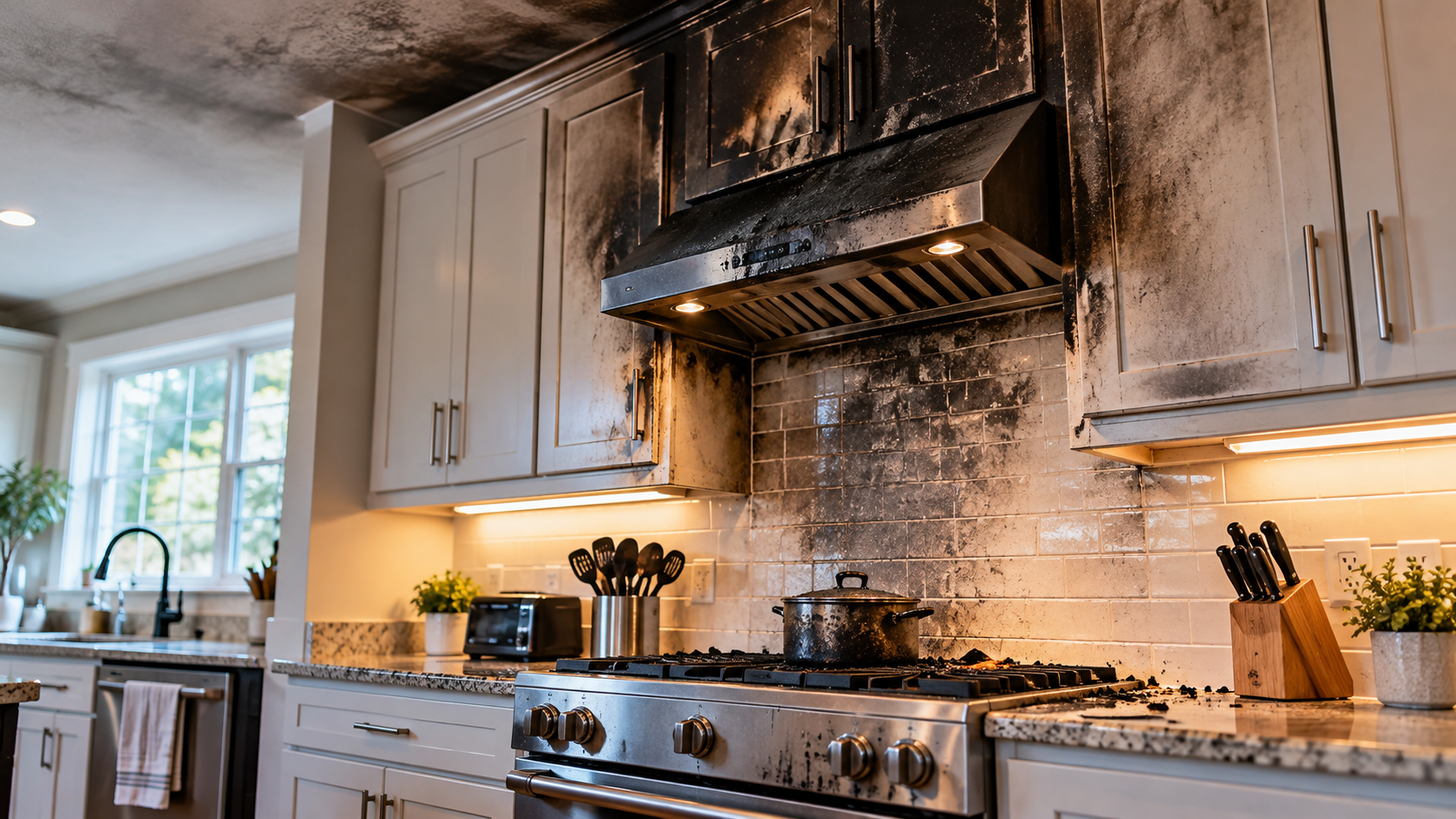
A kitchen fire can last only minutes, but the damage it leaves behind can affect an entire property.
According to the U.S. Fire Administration (USFA), cooking accounted for 51% of residential building fires with determined causes during 2017–2019. During that period, fire departments responded to an estimated 187,500 residential cooking fires annually.
These fires resulted in an estimated $444 million in annual property losses, along with thousands of injuries.
While many cooking fires are contained quickly, property owners often underestimate the damage that smoke, soot, and heat can leave behind.
Kitchen Fires: A Common but Underestimated Threat
Cooking is one of the most routine activities in any household, yet it remains a leading source of residential fires.
A forgotten pan, overheated cooking oil, or unattended stovetop can quickly create a dangerous situation.
The USFA identified unattended equipment as a leading contributing factor in cooking fires that spread beyond the cooking vessel.
For homeowners in Atlanta and throughout Georgia, these statistics highlight a serious concern: even a relatively small kitchen fire can create restoration challenges that extend beyond the immediate cooking area.
Smoke Damage Doesn’t Stay in the Kitchen
When most people imagine fire damage, they picture burned cabinets, damaged appliances, and blackened walls.
However, the visible damage may represent only part of the problem.
Smoke and airborne particles can travel through hallways, doorways, ventilation pathways, and openings within a building.
Depending on the conditions of the fire, soot and combustion residues may settle on surfaces far from the original flames.
Living rooms, bedrooms, furniture, and building materials may be affected even when they show no visible signs of burning.
This is why evaluating a fire loss based solely on what appears burned can overlook important restoration concerns.
The Hidden Problem With Smoke and Soot
Not all fire residues are the same.
Different materials produce different types of combustion byproducts, and those residues can behave differently when they contact building surfaces.
Some leave visible discoloration. Others may contribute to persistent odors or contamination that is difficult to recognize without a thorough evaluation.
Porous materials, concealed spaces, and HVAC components can present additional restoration challenges.
A home that looks clean after a kitchen fire is not necessarily free of fire-related contamination.
The extent of damage depends on the materials burned, fire duration, ventilation conditions, and other property-specific factors.
Why Smoke Odors Can Remain After a Fire
One of the most frustrating problems following a kitchen fire is the smell of smoke that refuses to disappear.
Property owners may notice odors becoming more noticeable when temperatures change or the heating and cooling system operates.
Smoke-related odors can persist when affected materials or contamination sources have not been adequately addressed.
Masking an odor does not necessarily resolve the underlying issue.
Professional fire restoration considers both visible damage and the conditions contributing to lingering smoke odors.
Fire Damage Can Become a Larger Property Loss
The effects of a kitchen fire may involve more than smoke and burned materials.
Depending on the severity of the incident, properties can also experience water damage from firefighting efforts, damage to finishes, and contamination of personal belongings.
These overlapping conditions can complicate restoration decisions and increase the potential scope of property damage.
Early professional evaluation can help property owners better understand the extent of a loss before restoration and reconstruction decisions are made.
Professional Fire and Smoke Damage Restoration in Atlanta
At Edwards Environmental Consulting (EEC), we understand that fire damage doesn’t always end where the flames stop.
With more than 30 years of restoration industry experience, EEC provides specialized fire and smoke damage restoration services for residential and commercial properties.
Whether the loss involves a kitchen fire, widespread smoke contamination, or a complex commercial property, understanding the full extent of damage is essential.
Experienced a kitchen fire or dealing with lingering smoke damage?
Contact Edwards Environmental Consulting to discuss your property and professional restoration needs.
Call: (470) 540-9269
Email: info@eccrs.net
Website: https://eccrs.net
Source: U.S. Fire Administration, “Cooking Fires in Residential Buildings (2017–2019),” July 2021.
Leave a Reply